SpaceX’s satellite internet service, Starlink, has extended its high-speed, low-latency broadband connectivity to Guinea-Bissau, marking another major milestone in the company’s mission to connect underserved regions across Africa.
The announcement, made earlier today via the official @Starlink account on X (formerly Twitter), showcases a significant step toward bridging Africa’s digital divide—especially in a country where nearly 67.5% of the population lacked reliable internet access.
From License to Launch: Starlink’s Fast Entry into Guinea-Bissau
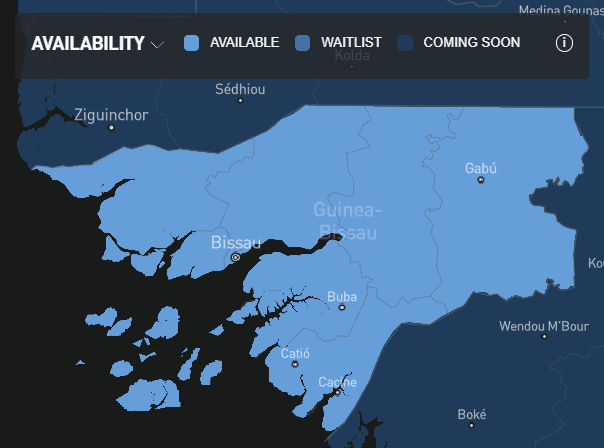
Starlink received a provisional license to operate in Guinea-Bissau in December 2024, and in less than six months, the service has launched and gone live across several regions. Cities such as Bissau, Buba, and Gabú are marked “Available” on Starlink’s coverage map, while other locations remain on a “Waitlist” or tagged “Coming Soon,” suggesting a phased deployment.
This rollout comes shortly after Starlink’s launch in the Democratic Republic of Congo (DRC), Somalia, and Lesotho earlier in 2025—expanding its African footprint to 23 countries, including Nigeria, Kenya, South Africa, Ghana, Uganda, and Rwanda.
With over 6 million global subscribers and a satellite network bolstered by 28 new LEO (Low Earth Orbit) satellites launched from Florida in recent weeks, Starlink is gaining significant momentum.
Why Starlink Matters for Guinea-Bissau
In Guinea-Bissau—a country with a GDP of just $1.6 billion and limited terrestrial infrastructure—the arrival of satellite-powered broadband is potentially transformative. Starlink offers download speeds of up to 150 Mbps, which could revolutionize sectors such as:
-
Education: Enabling remote learning platforms for schools in rural areas.
-
Healthcare: Supporting telemedicine and access to online diagnostics.
-
Commerce: Empowering small businesses and digital entrepreneurs.
This is especially critical in a nation where only 5% of rural areas previously had access to the internet.
A Broader African Push
Starlink’s launch in Guinea-Bissau is part of a wider strategy to connect the 600 million people across Africa who remain offline. The company’s website reiterates its mission to provide “internet access almost anywhere on Earth,” and Africa remains central to that ambition.
Currently, Starlink is negotiating with regulators in at least 10 more African countries, including Ethiopia and Senegal, to secure operational licenses. If successful, this could raise its presence to over 30 African countries, covering roughly 60% of the continent.
Ethiopia, for instance, is a potential key market, though its state-owned monopoly, Ethio Telecom, has complicated talks. In Senegal, however, regulatory engagement is moving forward following a 2024 MoU.
Barriers to Adoption
Despite the promise, Starlink faces several challenges:
-
Affordability: At $599 for hardware and a $50 monthly subscription, the service remains out of reach for many in countries like Eritrea and Somalia, where internet penetration is under 10%.
-
Regulatory Resistance: Some nations, such as South Africa, have stalled deployments over local ownership requirements under Black Economic Empowerment (BEE) laws, which demand 30% local equity.
-
Local Competition: Telcos like MTN, Airtel, and Safaricom offer cheaper alternatives in urban markets, limiting Starlink’s mass appeal.
-
Infrastructure Costs: Analysts estimate that SpaceX will need to invest nearly $1 billion annually to support its African expansion.

Looking Ahead: Opportunities and Uncertainties
Starlink’s progress presents a compelling case for a satellite-driven connectivity revolution in Africa. The World Bank projects that a 10% increase in internet access can boost GDP by 1.4% per year—a growth avenue countries like Guinea-Bissau urgently need.
Yet, success will depend on Starlink’s ability to:
-
Negotiate clear regulatory frameworks.
-
Build local partnerships.
-
Introduce affordable pricing models or community bundles.
-
Educate users on how to access and leverage the service for productivity.
Conclusion
Starlink’s expansion into Guinea-Bissau is more than a technological milestone—it’s a beacon of hope for digital inclusion in one of Africa’s least connected nations. With 23 African countries now under its coverage and negotiations underway in many more, SpaceX is positioning itself at the forefront of a new era in connectivity.
But as the race toward a connected continent accelerates, only time will tell whether Starlink can overcome the financial, political, and competitive hurdles that stand in its way.
Africa is watching. The satellites are already listening.