How Much Time Do Nigerian Workers Really Spend Away from Work? A Deep Dive into Public Holidays and Leave Culture

As Nigeria continues to navigate the complex terrain of economic recovery, unemployment, and global competitiveness, a new analysis from Nairametrics Research sheds light on a lesser-discussed but crucial component of the national workforce—time off.
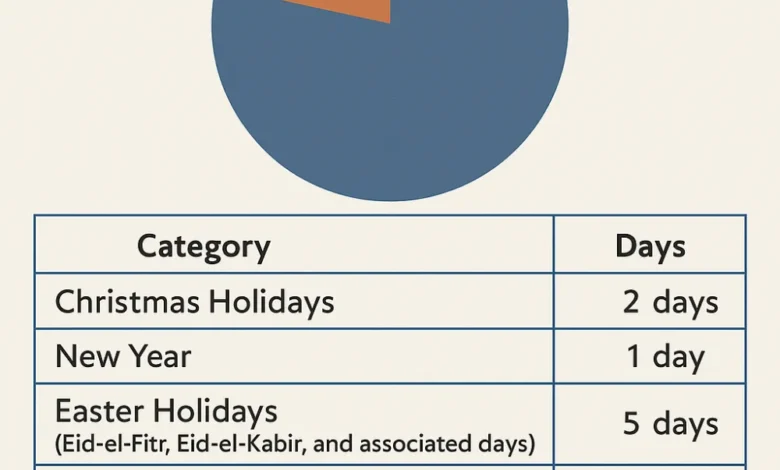
According to the report, Nigerian workers spend approximately 15.7% of their annual work calendar on leave or public holidays, amounting to between 41 and 46 days off in a typical year. The data is based on a standard calendar year of 261 working days, excluding weekends, and reflects a combination of public holidays, statutory annual leave, and sick leave entitlements.
🗓️ What Makes Up These Days Off?
Here’s a breakdown of the estimated 41–46 non-working days for the average Nigerian employee:
| Category | Days Off |
|---|---|
| Christmas Holidays | 2 (Dec 25 & 26) |
| New Year | 1 (Jan 1) |
| Easter Holidays | 2 (Good Friday & Easter Monday) |
| Muslim Holidays | 5 (Eid-el-Fitr, Eid-el-Kabir, and associated days) |
| Democracy Day | 1 (June 12) |
| Labour Day | 1 (May 1) |
| Independence Day | 1 (Oct 1) |
| Annual Leave (Statutory) | 20–28 |
| Sick Leave (Approximate) | 5 |
While not all employees take the full allowance of sick leave, most receive between 20 and 28 days of paid annual leave, depending on contract terms and length of service.
🧑⚕️ Essential Workers Not Always Included
It’s important to note that these figures do not apply to all sectors. Workers in essential services—such as healthcare, emergency response, security, and some shift-based roles—may not observe all public holidays or may work on rotational schedules, redistributing their time off.
🇳🇬 Holidays as a Cultural Imperative
In countries like the United States, “holidays” are often national or religious commemorations. In the UK and Commonwealth nations, the term is synonymous with vacation. But in Nigeria, public holidays are deeply interwoven with culture, religion, and family life.
From Eid to Christmas, Easter, and Democracy Day, these holidays serve as vital pauses for family reunions, religious reflection, and social bonding. While businesses often grumble about the disruption, many workers see these breaks as essential for mental health and emotional balance.
“These are not just days off,” says labour analyst Tunde Olatunji. “They are social resets for a country constantly under pressure from economic and security challenges.”
💼 Business vs. Well-being: A Divided Perspective
Despite the cultural significance, public holidays and official leave days often spark boardroom debates. Concerns revolve around mid-week holidays that break workflow momentum and reduced productivity in high-demand sectors.
A 2017 study by Botes highlighted measurable productivity dips during extended holiday periods in industries like logistics, finance, and manufacturing.
Yet, global research points to the long-term benefits of time off:
-
A 2006 Ernst & Young study (cited in Boyd, 2014) showed that each 10 hours of vacation taken improved annual performance ratings by 8%.
-
Studies by Kühnel & Sonnentag (2012) and Zenger & Folkman (2015) confirmed that rested employees are less likely to burn out and more likely to stay with their employers longer.
Closer to home, a 2020 survey of 247 bank workers in Anyigba, Kogi State, found that 90% of respondents viewed holidays as critical for religious observance, family time, and personal recovery.
⚖️ Striking the Right Balance
While the debate continues, most experts agree: a healthy work-life balance isn’t a luxury—it’s a necessity.
“We cannot optimize productivity without factoring in mental and emotional recovery,” says Dr. Ifeoma Obi, a workplace psychologist. “In a society like Nigeria, where people juggle multiple stressors, structured time off is a survival tool.”
There are, however, trade-offs. A Swedish study (Mohammed et al., 2018) found that holidays, while improving morale, could introduce stress-related health risks due to social obligations and financial pressures—a reality many Nigerians face, especially during festive seasons.
🔍 Conclusion: Time Off as Economic and Cultural Currency
With about 15.7% of workdays spent away from the office, Nigeria’s holiday culture reflects a nation balancing tradition, economic need, and workforce wellness.
For policymakers and employers, the challenge is not just about trimming time off—it’s about rethinking how rest, productivity, and culture can coexist in a sustainable, human-centered economy.
As debates over national productivity intensify, the Nigerian worker’s reality is clear: time off is not just expected—it’s earned, needed, and deeply valued.