Tensions Escalate in Downtown L.A. as Police Deploy Military-Style Tactics Against Protesters

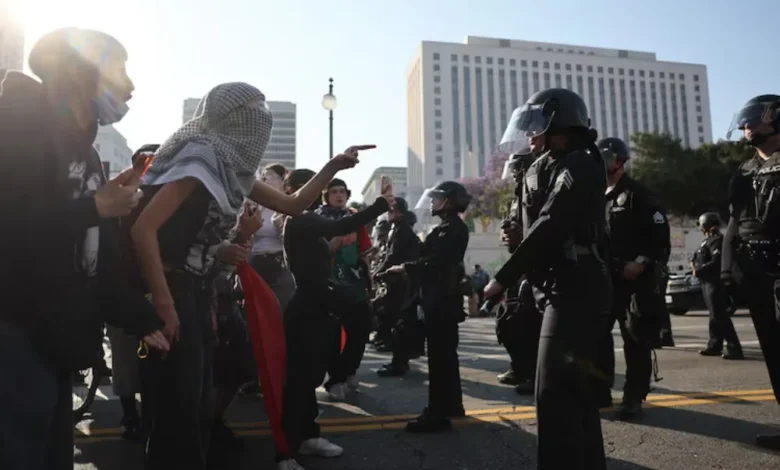
LOS ANGELES, June 9, 2025 — What began as another day of impassioned immigration protests in downtown Los Angeles turned into a tense standoff Monday, as law enforcement officials escalated their response with a display of overwhelming force outside federal buildings.
The protest, centered around the Edward R. Roybal Federal Building, saw demonstrators temporarily seize control of Los Angeles Street and attempt to access the nearby 101 Freeway. In response, police methodically ramped up their presence, building a heavily fortified perimeter while issuing repeated warnings to the crowd.
“Disperse now,” blared a voice over a bullhorn, warning protesters that they had five minutes to leave what authorities declared an “unlawful assembly.” Yet, even an hour after the announcement, officers had not yet moved in, despite the crowd’s growing defiance, chants, and jeers.
But the relative calm was short-lived.
From behind the police line, Los Angeles County Sheriff’s SWAT teams rolled into the scene in armored vehicles, accompanied by sound cannons and portable metal barricades. Simultaneously, LAPD cruisers and SUVs closed in from the opposite direction, effectively sealing off the street and encircling demonstrators in what resembled a coordinated military maneuver.
A Tactical Show of Force
Eyewitnesses described the operation as “a brigade-sized military exercise.” Officers took strategic positions in nearby parking structures, descending into the protest zone from multiple directions. In a sweeping pincer movement, authorities flushed demonstrators out from alleyways and street corners, forcing them into retreat.
Dozens of flash-bangs exploded through the area, and officers fired “less-lethal” munitions — including rubber bullets and bean bag rounds — to scatter the crowd. The air was thick with tension as hundreds of officers advanced, corralling remaining protesters out of the area.
Photos from the scene show a large contingent of California National Guard troops stationed in front of the federal building, while rows of riot police formed human barricades across Temple Street. Alameda Street, just blocks away, was similarly flooded with cruisers and heavily equipped officers, standing by in anticipation of further unrest.

A City on Edge
The Monday protests marked another flashpoint in what has become a nationwide series of demonstrations against federal immigration crackdowns. The Los Angeles protests, in particular, have drawn national attention due to the scale of the clashes and the federal government’s visible show of force.
While city officials have urged calm and stressed the importance of lawful assembly, many residents and civil rights groups are alarmed by what they describe as the militarization of local law enforcement. Critics argue that the response is disproportionate and risks escalating tensions further.
“This isn’t just crowd control,” one protester told local media. “This feels like a battlefield.”
Looking Ahead
With demonstrations continuing across major U.S. cities and plans for larger marches developing, authorities in Los Angeles are bracing for further unrest. Federal officials have not ruled out additional deployments, and civil rights advocates are calling for independent oversight into the tactics used against demonstrators.
As the sun set over a city gripped by uncertainty, one thing was clear: Monday’s protest was not the end — but merely another chapter in what appears to be a long and growing struggle over immigration, protest rights, and the balance between civil liberty and state authority in America’s largest cities.