U.S. Shifts Strategy in Sub-Saharan Africa: From Aid to Trade, Says Ambassador Mills

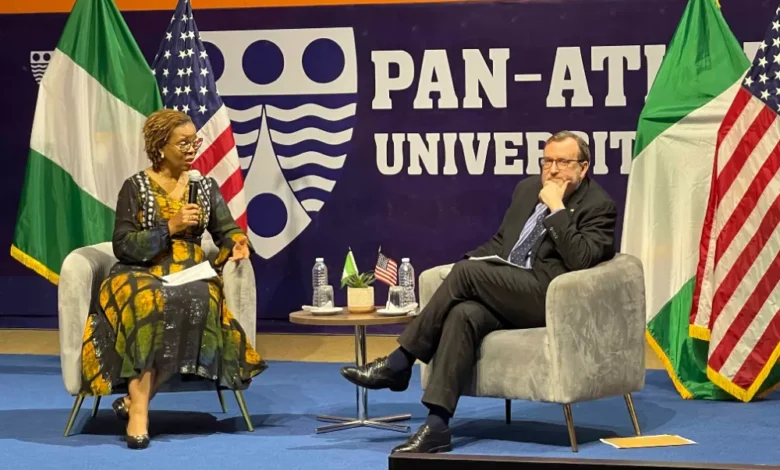
In what could mark a transformative shift in U.S.-Africa relations, the United States has unveiled a new commercial diplomacy strategy for Sub-Saharan Africa, signaling a pivot from traditional aid-based support to trade-driven engagement. U.S. Ambassador to Nigeria, Richard M. Mills, Jr., described the approach as a move to foster deeper economic partnerships and long-term prosperity for both the United States and African nations, particularly Nigeria.
Ambassador Mills made this announcement during a fireside chat hosted by the Lagos Business School (LBS) on the theme: “Toward a Robust U.S.-Nigeria Commercial and Investment Partnership.” The session was hosted by Professor Enase Okonedo, Vice Chancellor of Pan-Atlantic University, and preceded by a welcome address from Professor Olayinka David-West, Dean of LBS.
A New Era of U.S.-Africa Relations
The strategy, first announced by Ambassador Troy Fitrell, Chief of the Bureau of African Affairs at the U.S. State Department, during the Africa CEO Forum in Abidjan, underscores a bold ambition to redefine U.S.-Africa cooperation. It places Nigeria at the heart of this renewed focus.
“Our strong partnership is built on the rich connections that exist between our countries, our companies, our entrepreneurs, and our people,” said Ambassador Mills. “This is not about charity. It’s about mutual prosperity—a two-way street of opportunity.”
U.S.-Nigeria Economic Ties Strengthen
The Ambassador emphasized that Nigeria is already the United States’ second-largest trading partner in Africa, with bilateral trade in goods and services totaling nearly $13 billion in 2024.
In addition to trade, the U.S. remains a major investor in Nigeria, with foreign direct investment (FDI) reaching $6.5 billion in 2023, marking a 5.5% increase from the previous year.
“Nigeria is emerging to take its rightful place on the global stage,” Mills remarked. He spotlighted successful Nigerian-founded, U.S.-educated startups like Flutterwave, Andela, and Esusu as examples of the powerful connections between the two nations.
Education and Diaspora as Bridges
Ambassador Mills highlighted that 20,000 Nigerian students are currently enrolled in U.S. institutions—the highest of any African country and 7th globally. Nigeria also boasts the largest African diaspora in the United States, with more than 750,000 Nigerian-Americans contributing to cultural and economic ties.
Focused Pillars of Partnership: Agriculture, Digital Economy, Infrastructure
A cornerstone of the new strategy is the Commercial and Investment Partnership (CIP) agreement between the U.S. Department of Commerce and Nigeria’s Ministry of Industry, Trade and Investment. Nigeria is one of just five African countries with which the U.S. has signed such an agreement.
The five-year partnership is centered on three strategic pillars:
-
Agriculture: Boosting food production and value chains.
-
Digital Economy: Supporting innovation, digital inclusion, and tech entrepreneurship.
-
Infrastructure: Improving critical systems for transportation, power, and connectivity.
Joint working groups have been established to identify and resolve non-tariff trade barriers and regulatory hurdles, based on private sector feedback. Mills noted that these groups are already producing tangible outcomes.
Innovation on Display: AI and Digital Collaboration
One key result of these joint efforts was the Global Inclusivity and AI: Africa (GIAA) Conference held in Lagos last September. The event brought together public and private stakeholders to explore the role of AI in Africa’s future.
At the conference, Nigeria’s Communications Minister, Dr. Bosun Tijani, announced the launch of a ₦100 million fund to support local AI startups—a move welcomed by both Nigerian tech players and U.S. officials.
Kashifu Inuwa, Director-General of NITDA, emphasized ongoing collaboration with the U.S. Consulate General in Lagos, particularly around digital policy and innovation partnerships.
Notable attendees at the event included:
-
Olatunbosun Alake, Lagos State Commissioner for Science, Innovation, and Technology
-
Lauren Baker, Deputy Director, Office of Digital & Emerging Technology Services, U.S. ITA
-
Lola Adekanye, Country Manager, Centre for International Private Enterprise
-
Olumide Balogun, West Africa Director, Google
Looking Ahead
Ambassador Mills made it clear: the U.S. is doubling down on economic partnership with Nigeria, aiming to create lasting prosperity through trade, innovation, and strategic investment.
“We are making a shift from aid to trade,” he concluded. “It’s time we moved beyond development aid and toward sustainable economic collaboration that empowers both nations.”
With the groundwork now being laid through collaborative frameworks and forward-thinking agreements, the U.S.-Nigeria relationship is entering a bold new phase—one that places innovation, entrepreneurship, and equitable trade at its core.