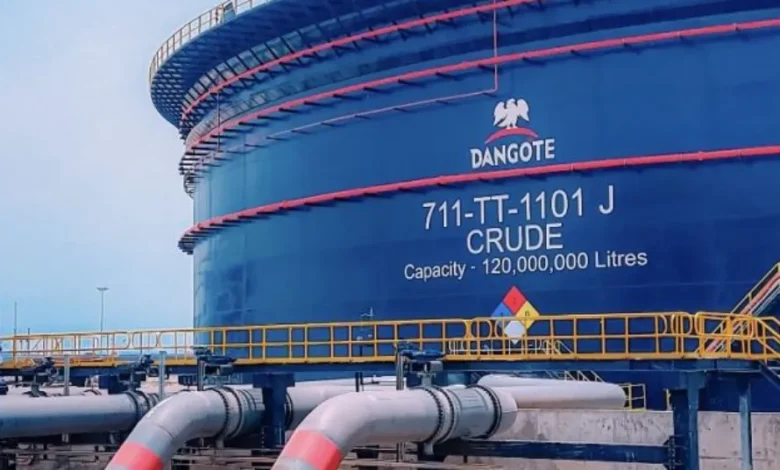
In a major shift in global oil trade dynamics, Nigeria — Africa’s largest oil producer — has significantly increased its imports of U.S. West Texas Intermediate (WTI) crude to meet the growing demands of the Dangote Oil Refinery. The refinery, which began ramping up production in 2024, is now one of the world’s most important crude-processing facilities, with a massive installed capacity of 650,000 barrels per day (bpd).
Owned by Africa’s richest man, Aliko Dangote, whose net worth is estimated at $28 billion, the refinery has quickly emerged as a key player in global crude sourcing and refining. Located near Nigeria’s commercial capital, Lagos, the refinery is central to the country’s energy ambitions, even as it turns to foreign crude to fuel its operations.
A Strategic Turn to U.S. Crude
According to Bloomberg’s ship-tracking data, the Dangote Refinery has sourced about one-third of its crude feedstock from the United States—primarily the WTI Midland grade. This figure has nearly doubled since 2024 and is expected to increase even further in June 2025.
Several factors contribute to the growing preference for American crude. Analysts cite the high gasoline and refined product yield from WTI as a major operational advantage for the Dangote Refinery. Additionally, ongoing U.S.-China trade tensions have reduced demand for WTI in parts of Asia, making more American crude available for African and other global buyers.
At the same time, the availability of Nigerian crude has been on the decline, compounding the need to seek stable external supplies. With OPEC members facing difficulties scaling production amid global competition, the Dangote Refinery has capitalized on stockpiled U.S. oil to support its journey toward full operational capacity.
WTI Midland: The Crude of Choice
Among the six global benchmark grades, WTI Midland has emerged as the dominant stream due to its consistent availability and favorable refining characteristics. It was added to the Brent pricing basket to offset declining production from North Sea grades such as Brent, Forties, Oseberg, Ekofisk, and Troll, which have historically formed the backbone of global crude pricing.
Traders tracking Dangote’s import patterns expect the refinery to take in around 14 million barrels of WTI Midland crude over the summer. Vitol Group, one of the world’s largest oil traders, has reportedly booked the majority of these U.S. barrels for delivery to Lagos.
From Crude to Community: Honoring President Tinubu
Beyond refining operations, Aliko Dangote has also emphasized infrastructure development tied to the refinery project. During the commissioning of the Deep-Sea Port Access Road — a vital route connecting the Dangote Fertilizer Plant to Eleko Junction in Lagos — Dangote announced the road has been named “Bola Ahmed Tinubu Road” in honor of Nigeria’s President.
“You are largely responsible for the Dangote Refinery complex,” Dangote said during the ceremony. “Despite economic headwinds, you’ve inspired investor confidence. I hope you continue this excellent work.”
The newly commissioned access road forms part of a larger logistics network aimed at integrating Nigeria with its regional neighbors, including Chad and Cameroon. It also links up with the Sagamu–Benin Expressway through the Epe–Ijebu–Ode corridor, facilitating cross-border trade and supply chain efficiency.
Crude Oil Markets Show Signs of Recovery
The week also brought good news for global oil markets. WTI crude rose by $1 per barrel in the final trading session, closing at $64 — a 2% gain and the first weekly increase in three weeks. A stronger-than-expected U.S. jobs report and renewed trade talks with China helped boost market sentiment.
OPEC’s May output data also contributed to the price rebound. Nine OPEC members increased production only marginally, while Libya—unbound by OPEC quotas—surged to a 13-year production high of 1.3 million bpd. Overall, OPEC’s May production reached 27.54 million bpd, up by about 200,000 bpd from April.
A New Era for Nigeria’s Energy Landscape
With the Dangote Refinery increasingly leaning on U.S. crude imports, Nigeria’s oil industry is entering a new phase. Once almost exclusively an exporter of crude oil, Africa’s biggest economy is now a significant importer of specific crude grades for domestic refining — a move that reflects both the country’s infrastructural advancements and the complexities of global oil economics.
As the Dangote Refinery moves closer to full-scale operations, its sourcing strategy, infrastructure development, and market integration will continue to shape not just Nigeria’s energy landscape but also influence broader trends across Africa and the global crude oil market.