From Rooftops to Resilience: How Google’s Open Buildings Dataset Is Powering Health and Climate Solutions Across Africa

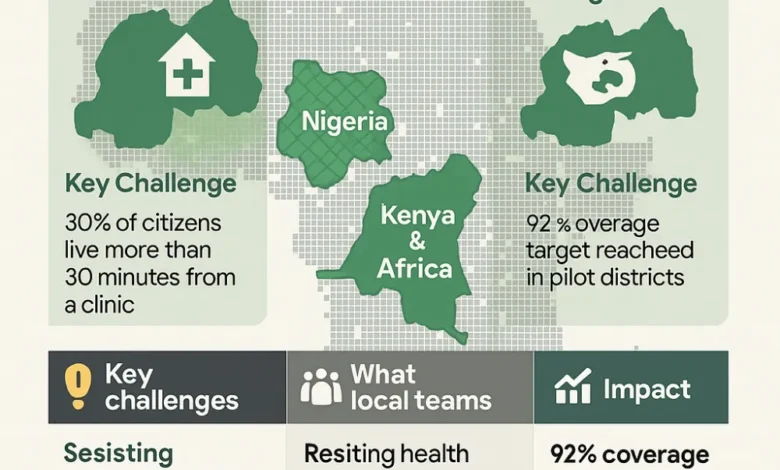
Across Africa, a quiet data revolution is underway—transforming satellite images into life-saving and climate-smart decisions. In countries like Rwanda, Nigeria, and South Africa, health planners and climate analysts are now using Google’s Open Buildings dataset to close service gaps, boost resilience, and guide smart investments in public infrastructure.
Developed by Google Research Africa in Accra, the Open Buildings dataset turns high-resolution satellite imagery into the most comprehensive public map of human settlements ever released. Each polygon in the dataset represents an individual roof, offering granular insights into where people live—even in the most remote or rapidly growing areas.
Spanning 58 million square kilometers, the dataset includes 1.8 billion building detections across Africa, South Asia, Southeast Asia, Latin America, and the Caribbean. This allows governments and NGOs to estimate population density and infrastructure needs without costly fieldwork—unlocking vital data in some of the world’s most underserved regions.
How Africa Is Putting the Dataset to Work
With the Open Buildings dataset, artificial intelligence is moving beyond pilot projects to become a powerful engine for public service delivery. From vaccination campaigns in Nigeria to clinic site planning in Rwanda and flood risk mapping in South Africa, here’s how local teams are using the tool to drive real-world change:
1. Rwanda: Bringing Healthcare Closer to Rural Communities
In Rwanda, the Ministry of Health and Kigali-based Sand Technologies are using the dataset to redesign the national network of rural clinics. The goal: ensure 92% of citizens live within a 30-minute journey—on foot, by motorcycle, or road—from essential healthcare services.
Using Open Buildings data to model travel times and reveal hidden healthcare deserts, planners have already resited proposed facilities in two pilot provinces. Once built, the new network will reduce the long journeys that endanger mothers and newborns—and the workflow is now being expanded to optimize the locations of pharmacies and ambulance hubs.
2. Nigeria: Mapping and Reaching Zero-Dose Children
In Northern Nigeria, a partnership between AFENET (African Field Epidemiology Network) and WorldPop at the University of Southampton leveraged Open Buildings data to identify unmapped settlements and boost vaccination coverage.
In just six months:
-
10,250 buildings were verified in Katsina State’s Yamma 2 ward.
-
Outreach teams used this data to locate and vaccinate over 70% of zero-dose children—those who had never received a single dose of DPT, measles, or polio vaccines.
-
This effort cut zero-dose pockets by 65%, with all mapped settlements now added to the national database for future health and nutrition programs.
“Open Buildings gives us the roof-level detail to build accurate population grids where traditional data is missing,” said Dr. C. Edson Utazi, Associate Professor of Spatial Data Science at WorldPop.
3. South Africa and Kenya: Building Climate-Resilient Cities
Flooding remains one of Africa’s most pressing urban threats. In Kigali, Johannesburg, Musanze, Gqeberha, and Dire Dawa, the World Resources Institute (WRI) is combining Open Buildings data with 2D flood models to produce block-by-block risk maps.
These detailed maps:
-
Help engineers quantify house-by-house flood exposure—even in informal settlements.
-
Are now part of early-warning systems in cities like Nairobi, which is still recovering from the May 2024 floods that displaced over 278,000 residents.
-
Guide nature-based solutions to restore river ecosystems and enhance resilience.
“This detailed data was instrumental in shaping our approach to fostering innovative nature-based solutions that will enhance Nairobi’s resilience,” said Walter Samuel, Geo Analytics Project Manager at WRI.
Why It Matters
Africa is home to 8.7 million zero-dose children, while urban populations are set to nearly double by 2035—pressuring governments to build smarter, faster, and more inclusively. Without reliable ground data, vital services—from vaccines to drainage—often miss the people who need them most.
By offering free, scalable, and open-access geospatial data, Open Buildings empowers local teams to channel limited budgets to high-impact areas. The dataset not only democratizes access to advanced satellite data but also aligns with a growing movement toward locally driven, ethically guided AI across the continent.
“These projects show what happens when local expertise meets open, scalable technology,” said Dr. Aisha Walcott-Bryant, Head of Google Research Africa. “Mothers reach clinics sooner, children receive long-overdue vaccines, and city planners get ahead of the next flood. AI’s highest calling is to solve real-world challenges.”
Summary of Impact: How Open Buildings Is Changing Lives
| Sector & Country | Key Challenge | What Local Teams Are Doing | Impact |
|---|---|---|---|
| Health Access – Rwanda | 30% of citizens live more than 30 minutes from a clinic | Redesigning rural health network | 92% coverage target reached in pilot districts |
| Immunization – Nigeria | 2.1 million “zero-dose” children across northern Nigeria | Mapping and guiding vaccinators to hidden settlements | 78,000 previously unvaccinated children reached; 40% fewer wasted visits |
| Urban Resilience – Kenya, SA | Frequent floods displace thousands and threaten informal settlements | Combining flood risk models with Open Buildings data | Early-warning zones created in Nairobi; now used in Johannesburg & beyond |
Final Thoughts
From lifesaving clinics to climate-smart cities, Google’s Open Buildings dataset is more than just a collection of rooftops—it’s a gateway to equitable development, helping African nations move from problem to solution with data-driven confidence.
As AI continues to evolve, its impact on the ground is already being felt—in every child vaccinated, every community mapped, and every family moved out of harm’s way.