Nigeria Boosts Military Capabilities with Local Production of Armoured Vehicles, Drones, and Bulletproof Components

In a major stride towards self-reliance in defense manufacturing, Nigeria has commenced the local production of key military equipment, including Armoured Personnel Carriers (APCs), bulletproof glass, surveillance drones, and critical spare parts. This development was confirmed by the Minister of Defence, Mohammed Badaru Abubakar, in a statement released on Wednesday by his media aide, Mati Ali.
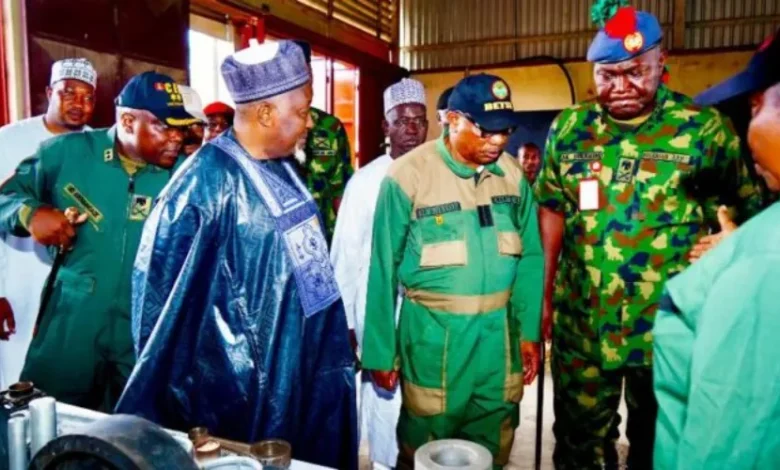
The announcement follows the Minister’s two-day working tour of major military establishments in Kaduna State, where he assessed ongoing projects and operational advancements. The visit included stops at the Nigerian Defence Academy (NDA), the Army Command Engineering Depot (CED), Buffalo Engineering Technical Services Limited (BETSL), and the Air Force Institute of Technology (AFIT).
Advancing Military Self-Reliance
Accompanied by top-ranking military officials, Minister Badaru inspected several facilities and interacted with personnel engaged in the refurbishment and manufacturing of military hardware. Among the notable accomplishments was the successful development of combat-ready platforms such as Buffalo APCs, Mine-Resistant Ambush Protected vehicles (MRAPs), bulletproof materials, and surveillance Unmanned Aerial Vehicles (UAVs)—many of which have already been deployed to Nigeria’s operational theaters.
“The ongoing efforts in training, local production, and refurbishment of military assets are commendable,” the Minister said.
“I witnessed impressive capabilities in repairing damaged MRAPs, tanks, and APCs, alongside the development of new platforms that are already being utilized in the field.”
Innovation as the Cornerstone
Badaru emphasized the strategic importance of research, development, and innovation (RDI) in improving the Nigerian military’s efficiency and reducing dependence on foreign suppliers. He also reiterated the federal government’s commitment—under President Bola Ahmed Tinubu’s leadership—to enhancing national defense through robust policy support.
The Minister pointed to the signing of the Defence Industries Corporation of Nigeria (DICON) Bill into law in late 2023 as a watershed moment. The legislation not only strengthens DICON’s mandate to manage defense manufacturing but also establishes the Defence Industry Technology, Research, and Development Institute (DITRDI). This institute is expected to become the epicenter of military innovation and technology commercialization in the country.
A Growing Ecosystem for Defense Manufacturing
Badaru’s tour underscored the need to support institutions like NDA, AFIT, CED, and BETSL, which play a pivotal role in training skilled military personnel and engineering experts. Their efforts are vital in building the workforce and technical infrastructure necessary for Nigeria’s defense industrialization goals.
Despite the progress, full self-sufficiency remains a work in progress. Much of the raw material, especially steel used in the production of military-grade equipment, is still imported. However, the federal government is actively pursuing partnerships to change this. In March 2025, the Minister of Steel Development, Shuaibu Audu, disclosed talks to forge a formal alliance between DICON, the Ministry of Defence, and Ajaokuta Steel Company.
Strategic Outlook
The local production of APCs, bulletproof components, UAVs, and spare parts marks a significant milestone for Nigeria’s military-industrial ambitions. It not only enhances the country’s defense readiness but also opens doors for long-term economic benefits through job creation, technology transfer, and export potential.
As Nigeria continues to navigate complex security challenges, these advancements signal a shift toward a more autonomous and innovative military apparatus—one that could shape the future of defense on the African continent.