JAMB’s 2025 Cut-Off Marks Spark Debate Over Declining Education Standards in Nigeria


July 2, 2025
The Joint Admissions and Matriculation Board (JAMB) on Tuesday released the official admission cut-off marks for the 2025/2026 academic session, igniting a renewed wave of public discourse about the quality of higher education in Nigeria.
According to JAMB, the minimum admissible scores are as follows:
-
Universities: 150
-
Polytechnics and Colleges of Education: 100
-
Colleges of Nursing Sciences: 140
These figures were agreed upon in collaboration with heads of tertiary institutions during a policy meeting. However, the decision has raised questions about academic standards, especially considering that the highest benchmark—150 for universities—falls significantly below the average UTME score of 200.

Lower Marks, Greater Access?
JAMB Registrar Prof. Ishaq Oloyede defended the board’s decision, stating that the move is part of a broader strategy to democratize access to higher education, especially in technical and teacher-training institutions.
“This policy is meant to expand opportunity for students from underserved areas and address the country’s growing demand for skilled manpower,” JAMB noted.
Yet, critics argue that lower cut-off marks risk further deteriorating Nigeria’s educational quality. The most frequent concern is that access without adequate academic rigor could lead to a flood of underprepared students entering a system already facing chronic underfunding and infrastructural decay.
JAMB 2025: Better Results, Lower Expectations?
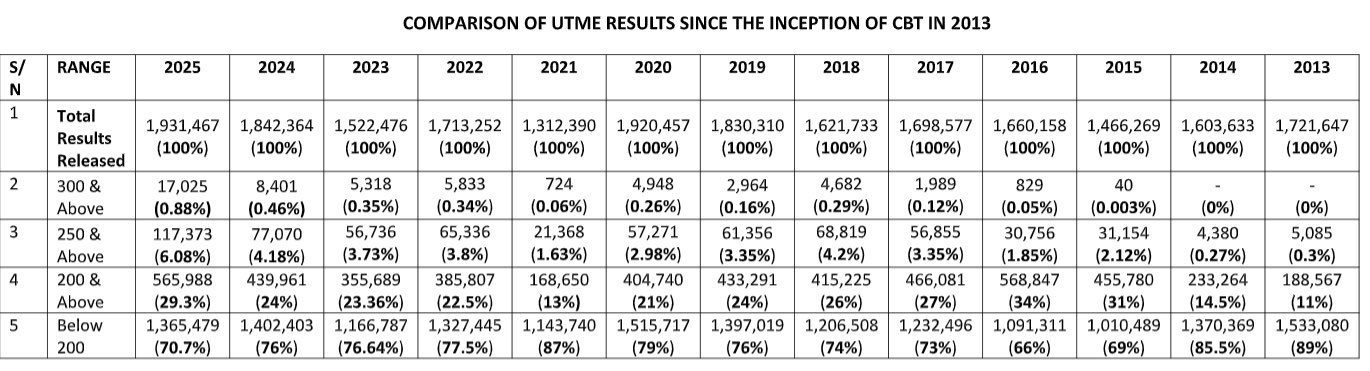
Ironically, the 2025 UTME results have been the best in eight years, according to JAMB’s own data. From the 1.93 million candidates who sat for the exam:
-
0.88% (17,025) scored 300 and above
-
6.08% (117,373) scored 250 and above
-
29.3% (565,698) scored 200 and above
These figures represent the strongest performance since 2017, beating out 2023 and 2024. Despite this, the cut-off mark remains low, intensifying the conversation around a disconnect between exam performance and admission standards.
Cut-Off Trends: A Historical Look
When compared to previous years, the 2025 university cut-off mark of 150 appears moderate, yet still far below earlier benchmarks. Here’s how the marks have shifted over time:
| Year | Universities | Polytechnics | Colleges of Education |
|---|---|---|---|
| 2025 | 150 | 100 | 100 |
| 2024 | 140 | 100 | 100 |
| 2023 | 140 | 100 | 100 |
| 2018 | 140 | 120 | 120 |
| 2017 | 120 | 100 | 100 |
| 2013–2016 | 180 | 150 | 150 |
The trend shows a gradual dilution in entry requirements, reflecting a troubling shift in how academic merit is evaluated in the Nigerian tertiary system.
Social Media and the Shifting Value of Education
The reaction on social platforms has been fierce. Many users blame social media fame, financial pressures, and poor funding as reasons for waning interest in formal education.
“Setting the university cut-off at 150 is a glaring sign that the standard of education in Nigeria is crumbling,” one X (formerly Twitter) user said. “These days, fame pays more than a Master’s degree.”
Are Top Institutions Lowering Standards Too?
While federal institutions like UNILAG, UI, and OAU still maintain higher internal cut-offs (often around 200), even their departmental benchmarks are slipping.
UNILAG’s Cut-Offs for Medicine & Law:
-
2022/2023: Medicine – 86.825 | Law – 80.375
-
2023/2024: Medicine – 84.675 | Law – 76.025
-
2024/2025: Medicine – 82.125 | Law – 76.025
UI’s Cut-Offs:
-
Medicine: Rose to 79 in 2023/2024 but dropped to 78.125 in 2024/2025
-
Law: Maintained 67.25 after a slight rise
Global Rankings Reflect the Crisis
Further emphasizing the decline, no Nigerian university ranked among the top 1,000 in the 2026 QS World University Rankings. Only UI and UNILAG appeared in the 1001–1200 category, while ABU lagged further behind in the 1201–1400 range.

The Trade-Off: Access vs. Quality
JAMB argues that lowering cut-off marks promotes inclusion and caters to disadvantaged students. But many education experts caution that this policy could result in a generation of under-skilled graduates, particularly in competitive sectors like engineering, law, and medicine.
“We’re not against access,” one education analyst said. “But let’s not pretend that flooding the system with students who scored far below average will lead to better outcomes.”
In Conclusion
The 2025 JAMB cut-off marks reignite a critical debate at the intersection of access, quality, and equity in Nigerian education. While JAMB’s position leans toward inclusion, many fear that the long-term cost may be a further erosion of standards—one that may be harder to recover from in a world demanding increasingly competitive graduates.
As the nation awaits institutional responses and policy actions, one thing remains clear: education in Nigeria is at a crossroads, and the decisions made today will shape the intellectual and economic future of the country for generations to come.