Nigerian Solar Users Can Now Sell Excess Power to Electricity Companies: Here’s How It Works


For years, Nigerians turned to solar power out of necessity rather than choice. With distribution companies delivering unreliable electricity and tariffs climbing steadily, homes and businesses that could afford solar systems opted out of the grid altogether. Any excess power generated by their panels — which is almost inevitable — simply went unused.
That dynamic is beginning to change. The Nigerian Electricity Regulatory Commission has started implementing its Net Billing Regulations 2026, creating, for the first time, a formal legal and operational framework that allows eligible electricity users to generate power for their own needs and sell surplus energy back to distribution companies.
The timing is significant. Nigeria recorded a 141% year-on-year increase in new solar installations in 2025, making it Africa’s second-largest solar market after South Africa. More than four million solar panels, valued at about $200 million, were imported in 2023 alone, reflecting surging demand across both urban and rural areas. By early 2025, local solar manufacturing capacity had expanded from 110 megawatts to 600 megawatts, boosted by a new 100-megawatt facility in Lagos. Solar power has moved beyond being an alternative solution — it is now part of Nigeria’s core energy infrastructure.
The frustration driving this shift is familiar. Distribution companies have long faced criticism for estimated billing, poor supply, and tariff increases that are not matched by service improvements. Yet despite Nigeria’s rapid solar adoption, grid-connected solar contributed only about 0.2% of total electricity generation as recently as 2024. Most solar systems operated in isolation, benefiting only their owners.
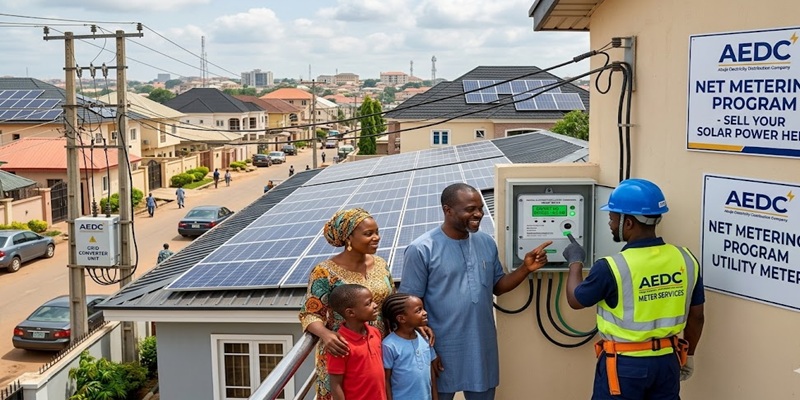
The new regulations aim to change that by introducing “prosumers” — users who both produce and consume electricity. Under the net billing model, a prosumer uses solar power for on-site needs and exports excess energy to the grid. Instead of that power being wasted, the user receives credits based on an export tariff approved by NERC.
However, participation is limited to larger installations. Eligible systems must have a minimum capacity of 50 kilowatts peak and a maximum of 1.5 megawatts peak, effectively excluding most residential rooftops. This means the initial beneficiaries will be commercial and industrial users such as factories, hotels, hospitals, office complexes, and large retail facilities.
To participate, an applicant must first request a technical feasibility assessment from their distribution company. If the network can safely accept the additional power and the installation meets required standards, the user signs a net billing agreement and registers with NERC. A bidirectional meter is then installed to track both imported and exported electricity, with credits calculated based on the approved tariff.
Even before net billing, commercial and industrial solar users were already saving between 20% and 30% compared to diesel generation. The ability to earn from excess power further improves the economics, turning previously wasted energy into a new revenue stream at a time when electricity costs continue to rise.
Beyond individual savings, the policy signals a broader shift in Nigeria’s energy model. Electricity generation is no longer strictly one-directional. By integrating distributed solar generation into the grid, the burden of meeting national power demand becomes more shared, flexible, and resilient.

Nigeria’s renewable energy capacity is projected to reach over 14 gigawatts by 2031, growing at an annual rate of more than 25%. The Net Billing Regulations suggest the country intends not only to grow that capacity, but also to ensure Nigerians who have already invested in clean energy can directly benefit from it.

