Trump, Hegseth Defend U.S. Pilots and Nuclear Strike Claims Amid Mixed Intel Reports on Iran Attack

June 26, 2025
President Donald Trump and Defense Secretary Pete Hegseth pushed back strongly on Wednesday against a preliminary U.S. intelligence assessment suggesting that recent airstrikes on Iranian nuclear sites caused only limited damage. The two officials accused the media of misrepresenting the mission’s success and undermining the American pilots who carried out the operation.
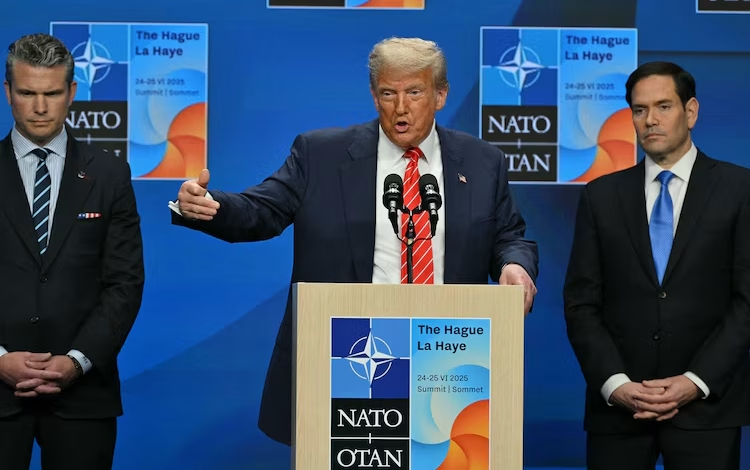
Speaking during a press conference at the NATO summit in The Hague, Netherlands, Trump insisted the mission was a complete success and blasted what he called “fake news” for suggesting otherwise.
“You should be praising those people instead of trying to get me,” Trump told reporters. “You’re hurting those people.”
“They were devastated. They put their lives on the line.”
The Contested Report
Trump was responding to an initial assessment by the Defense Intelligence Agency (DIA), which indicated that the strikes on Iran’s nuclear facilities in Natanz, Isfahan, and Fordo may have only delayed Iran’s nuclear program by a few months, contrary to the administration’s public claims of obliteration.
When asked about the report, Trump acknowledged having received it but insisted it was “incomplete” and emphasized instead that he had spoken directly with one of the B-2 bomber pilots.
“He said, ‘Sir, we hit the site. It was perfect. It was dead on.’ Because they don’t understand fake news.”
Rallying Behind the Pilots
Both Trump and Hegseth framed the criticism as an attack on the pilots rather than the strategy or intelligence. Hegseth, who stood alongside Secretary of State Marco Rubio and Trump during the press conference, delivered a fiery defense of the mission.
“These pilots, these refuelers, these fighters, these air defenders—the skill and the courage it took to go into enemy territory flying 36 hours—is beyond what anyone in this audience can fathom,” said Hegseth.
Hegseth also announced he would hold a separate press conference Thursday morning to defend “the dignity of our great American pilots,” according to a Truth Social post by Trump later that day.
“They felt terribly! Fortunately for them and, as usual, solely for the purpose of demeaning PRESIDENT DONALD J. TRUMP,” Trump posted. “The News Conference will prove both interesting and irrefutable.”
Disputing the Intelligence Leaks
Trump dismissed the notion that the strikes were anything less than fully effective. Citing an Israeli intelligence report, he claimed that the Fordo site had been “destroyed” and rendered “totally inoperable.”

However, U.S. military officials have stated that while the strikes caused significant damage, a full battle damage assessment (BDA) was still underway. As of Wednesday, no Western officials had conducted in-person inspections at the sites, making definitive conclusions premature.
Director of National Intelligence Tulsi Gabbard echoed the president’s stance in a post on X (formerly Twitter), stating unequivocally that “Iran’s nuclear facilities have been destroyed.” Gabbard criticized the media’s portrayal of the classified report, alleging selective leaks and mischaracterizations.
“The propaganda media has deployed their usual tactic: selectively release portions of illegally leaked intelligence… to try to undermine President Trump’s decisive leadership,” she said.
A source familiar with Gabbard’s position confirmed to ABC News that her remarks were based on new intelligence that went beyond the DIA’s preliminary analysis.
Hegseth Doubles Down
Hegseth didn’t shy away from criticizing both the press and the intelligence community for leaking what he described as low-confidence assessments.
“If you want to make an assessment of what happened at Fordo, you better get a big shovel and go really deep because Iran’s nuclear program is obliterated,” he said.
He accused unnamed insiders of leaking preliminary findings in an effort to downplay a mission he characterized as historic.

Broader Implications
Saturday’s strike on Iran’s nuclear infrastructure, ordered by Trump, has drawn significant international attention and sparked debate over its effectiveness, potential blowback, and long-term implications for U.S.-Iran relations.
Critics argue that Trump’s claims of a decisive victory could undercut future diplomatic efforts, especially if the Iranian nuclear program resumes faster than expected. Meanwhile, supporters hail the action as a demonstration of American military precision and resolve.
Regardless of the final assessment, the White House has clearly shifted into defense mode—fighting not just Iran’s nuclear ambitions, but also the narrative surrounding America’s actions on the global stage.
As battle damage reports continue to emerge and the intelligence community refines its evaluations, both the effectiveness of the strike and the political ramifications will remain central topics in U.S. foreign policy discourse.