Nigeria’s Digital Economy Contributes N7 Trillion to Q1 2025 GDP, Despite Slight Dip from Previous Quarter


The National Bureau of Statistics (NBS) has revealed that Nigeria’s Digital Economy sector contributed N7 trillion to the country’s real Gross Domestic Product (GDP) in the first quarter of 2025, representing 14.19% of the total N49.34 trillion GDP for the period.
This was disclosed in the NBS’s Q1 2025 GDP report, which also showed a year-on-year GDP growth rate of 3.31%—a slight improvement from the 2.27% recorded in Q1 2024, but lower than the 3.76% growth in Q4 2024. Quarter-on-quarter, however, the economy contracted slightly, with total GDP dropping from N61.4 trillion in Q4 2024 to N49.34 trillion in Q1 2025.
Breakdown of the Digital Economy Sector
The Digital Economy comprises two primary segments:
-
Information and Communication (I&C)
-
Financial Institutions (FI)
Information and Communication (I&C) Sector
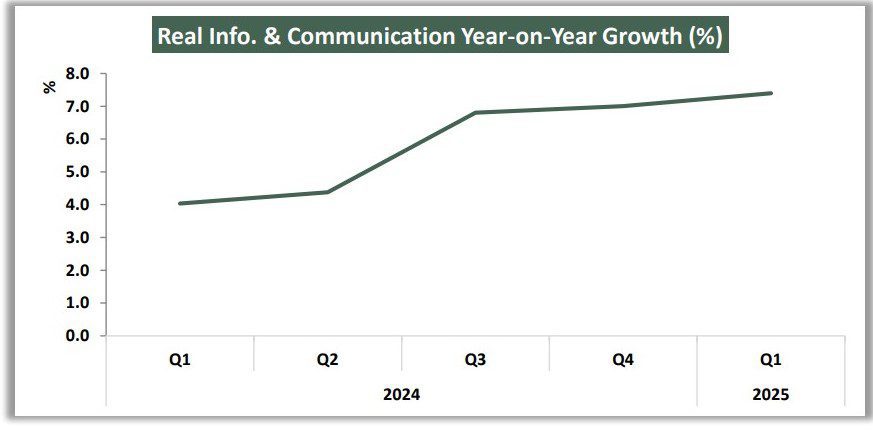
The I&C sector accounted for a real GDP contribution of 10.59% in Q1 2025, up from 10.17% in the same period of 2024. Despite a -8.86% quarter-on-quarter contraction, the sector posted a healthy 7.40% year-on-year growth in real terms.
In monetary terms, the I&C sector contributed N5.2 trillion to the real GDP, with telecommunications alone responsible for a massive 80% (about N4.2 trillion) of this value. Other contributors included broadcasting, publishing, and sound/music production.
Financial Institutions (FI) Sector
The FI sector, which includes both banks/fintechs and insurance companies, contributed 3.60% to real GDP in Q1 2025. This represents a modest year-on-year growth of 0.37 percentage points and an impressive 15.03% real growth rate.
In monetary terms, the FI sector added N1.8 trillion to the economy, with banks and fintechs making up 90.74% of this figure (N1.6 trillion), while insurance firms contributed the remaining 9.26% (around N200 billion).
Performance Compared to Q4 2024
Although the sector’s Q1 contribution was strong, it marked a slight dip from the previous quarter. In Q4 2024, the digital economy contributed N7.2 trillion (11.8% of N61.4 trillion), while Q1 2025 saw a 2.8% drop in both real value and contribution due to the overall contraction in the economy.

Digital Economy Q1 2025 vs Q4 2024 Highlights:
-
Q4 2024 Contribution: 11.8% (N7.2 trillion)
-
I&C: 9.34% (N5.7 trillion)
-
FI: 2.46% (N1.5 trillion)
-
-
Q1 2025 Contribution: 14.19% (N7 trillion)
-
I&C: 10.59% (N5.2 trillion)
-
FI: 3.60% (N1.8 trillion)
-
Rebased GDP and Broader Economic Trends
The NBS also released updated figures for Nigeria’s rebased GDP, using 2019 as the base year. According to the new data:
-
2020: -6.96%
-
2021: 0.95%
-
2022: 4.32%
-
2023: 3.04%
-
2024: 3.38%
These figures indicate a recovery trend post-COVID, with services and industry sectors contributing significantly alongside the digital economy.

Foreign Investment and Government Policy
The digital economy has also been a key driver of foreign direct investment (FDI). The sector attracted $191 million in FDI during Q1 2024, marking a 900% increase from the $22 million recorded in Q1 2023. The trend continued in Q2 2024 with $114 million, up 356% year-on-year.
This surge is largely attributed to government-led initiatives such as the 3 Million Technical Talent (3MTT) programme and the recently enacted National Digital Economy and E-Governance Act, 2024. These reforms are designed to accelerate Nigeria’s transition to a digitally inclusive economy.

Minister of Communications, Innovation, and Digital Economy, Dr. Bosun Tijani, noted that Nigeria’s digital transformation strategy is already yielding dividends. With unicorns like Flutterwave, Jumia, Moniepoint, Interswitch, and Andela leading the charge, the sector is projected to generate $18.3 billion by 2026.
Conclusion
Despite a minor dip in quarterly value, Nigeria’s Digital Economy remains a cornerstone of national economic growth, contributing significantly to GDP and attracting robust foreign investment. With strategic policies in place and continued private-sector innovation, the sector is poised for sustained impact in the years ahead.


