June 21, 2025 – Washington D.C.
The United States has officially resumed the processing of student visa applications for foreign nationals, following a temporary suspension in May 2025. However, this resumption comes with a controversial new requirement: all applicants must now submit their social media accounts for verification as part of an enhanced vetting process.
In a statement released Wednesday, the U.S. Department of State announced that foreign students applying under the F (academic), M (vocational), and J (exchange visitor) nonimmigrant visa categories will now undergo intensified screening, including a comprehensive review of their online activity.
“The U.S. has announced that it is resuming the suspended process for foreigners applying for student visas but will now require monitoring of the social media activities of the applicants,” the statement read.
A National Security Focus
This policy shift aligns with former President Donald Trump’s ongoing emphasis on strengthening national security and tightening immigration oversight. The Department of State reiterated that a visa is “a privilege, not a right,” emphasizing that visa approvals are subject to national security assessments.
“We use all available information in our visa screening and vetting to identify applicants who are inadmissible to the United States, including those who pose a threat to U.S. national security,” the Department stated. “Under new guidance, we will conduct a comprehensive and thorough vetting, including online presence, of all student and exchange visitor applicants.”
Applicants must now provide access to their active and past social media profiles as part of their application process. U.S. embassies and consulates have begun preparing to reopen student visa interview appointments, with applicants advised to check their local embassy websites for updates.
Nigeria and the Global Impact
The move is particularly significant for countries like Nigeria, which currently ranks as the top African source of international students in the U.S. With over 20,000 Nigerian students enrolled in American institutions, the resumption of visa processing is expected to ease uncertainties for thousands of prospective scholars.
However, the new social media requirement could pose additional hurdles for students from across Africa, Asia, and the Middle East, where internet expression may be misinterpreted or politicized during screening.

Background: Why the Suspension Happened
In May 2025, Secretary of State Marco Rubio ordered a temporary halt to student visa processing worldwide, citing the need to restructure the vetting process in response to growing national security concerns.
During that period, the U.S. paused interview scheduling for all student visa categories. The move drew criticism from educational institutions and foreign governments but was framed as necessary by the Trump administration to prevent individuals deemed a threat from entering the country.
“We take very seriously the process of vetting who it is that comes into the country, and we’re going to continue to do that,” said State Department spokesperson Tammy Bruce at the time.
The suspension also followed efforts to revoke the visas of international students involved in campus protests against the war in Gaza, with the Trump administration alleging links between some protesters and the Palestinian militant group Hamas.
Universities and Political Tensions
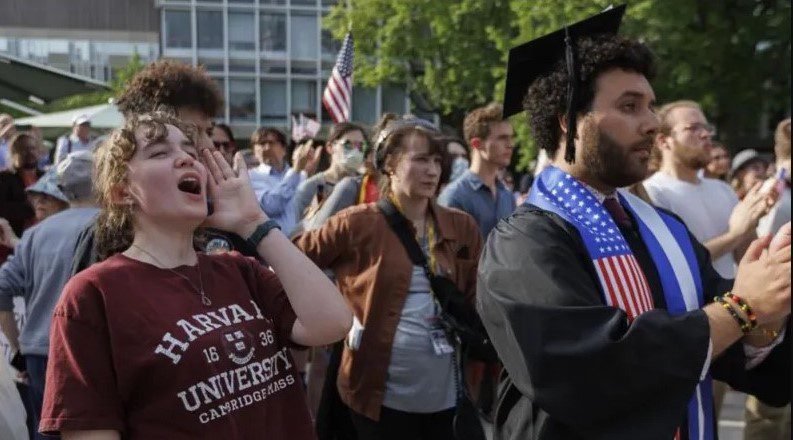
Elite U.S. universities like Harvard have found themselves at the center of Trump’s political crackdown. Trump has accused these institutions of failing to curb antisemitism and branded them as breeding grounds for opposition. Following pro-Palestinian protests, the administration announced its intention to cancel all remaining federal financial contracts with Harvard, sparking a wave of protests by students and faculty.
“This is just another attempt to force universities into submission,” one Harvard student protester told reporters.
In response, China urged the United States to uphold the rights of international students, noting that hundreds of thousands of Chinese nationals currently study in the U.S.
“We urge the U.S. side to earnestly safeguard the legitimate rights and interests of international students, including those from China,” said a spokesperson for the Chinese Ministry of Foreign Affairs.
The Bigger Picture
Foreign students contribute significantly to the U.S. economy and academic ecosystem. In many universities, they represent a substantial portion of the student population and often pay higher tuition rates. Their presence also boosts cultural exchange and global collaboration in research.
While the resumption of visa processing will offer relief to many aspiring students, the added social media surveillance requirement has sparked debate over privacy, freedom of expression, and the politicization of higher education.
For now, prospective international students are advised to prepare not only their academic documents but also their online profiles—because in today’s America, what you post might determine if you can study there.